By Sandra Berns FCIPD, Managing Director, Centric HR
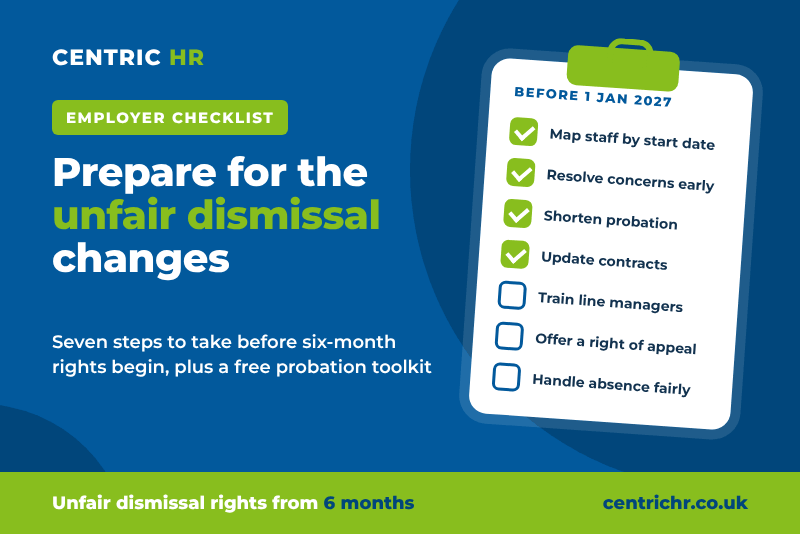
From 1 January 2027, employees in Great Britain can claim ordinary unfair dismissal after six months’ continuous service, down from two years. To prepare, employers should do five things before that date: identify which employees will gain protection on 1 January 2027, resolve any outstanding performance concerns fairly, shorten and structure probation periods, update contracts and offer letters and train line managers to document every review.
The change is no longer a proposal. The Employment Rights Act 2025 received Royal Assent on 18 December 2025, and the commencement regulations (SI 2026/559), made on 26 May 2026, confirm the 1 January 2027 start date. With fewer than eight weeks to go, this guide sets out the practical steps we are taking with clients now, along with the free templates and webinar we have produced to help.
If you would like the background on what the Act says about probation, read our earlier guide, Probation and Unfair Dismissal Rights: What the Employment Rights Act 2025 Means for Your Business. This article focuses on what to do next.
| What is changing | The detail | When it applies |
| Qualifying period for ordinary unfair dismissal | Reduced from two years to six months | Dismissals with an effective date of termination on or after 1 January 2027 |
| Compensation cap | The statutory cap on the compensatory award is removed entirely | Dismissals where the actual effective date of termination is on or after 1 January 2027 |
| Right to written reasons for dismissal | Also available after six months’ service | 1 January 2027 |
| Future changes to the qualifying period | Can only be made by a new Act of Parliament, not by regulations | Now in force |
| Day one rights | Discrimination and automatically unfair dismissal (for example whistleblowing, pregnancy, asserting a statutory right) remain day one protections | Unchanged |
The government’s own impact assessment estimates that the reduced qualifying period will extend unfair dismissal protection to a further 6.3 million employees and generate around 9,000 additional Acas early conciliation referrals each year. Removing the compensation cap also means a single claim involving a senior or well-paid employee carries considerably more financial exposure than before.
One point is frequently misreported. The final Act does not make unfair dismissal a full day one right, and it does not create a statutory probation period. Probation remains a contractual arrangement that each employer designs for itself.
Any employee with six months’ continuous service on 1 January 2027 gains protection on that day, whatever their start date and whether or not they are still on probation. In practice, that covers everyone who started on or before 1 July 2026 and is still employed. Employees who started later gain protection once they individually reach six months.
| Start date | Service on 31 December 2026 | Protected from |
| 1 March 2025 | 22 months | 1 January 2027 |
| 1 March 2026 | 10 months | 1 January 2027 |
| 1 July 2026 | 6 months | 1 January 2027 |
| 1 October 2026 | 3 months | 1 April 2027 |
This means a group of employees with between six months’ and two years’ service will gain protection several months, and in some cases well over a year, earlier than many employers had planned for.
Employees with more than one month’s service are entitled to at least one week’s statutory notice. Under section 97(2) of the Employment Rights Act 1996, if an employer dismisses without that notice, or makes a payment in lieu of notice, the statutory week is added to the termination date when calculating qualifying service.
The commencement regulations confirm this applies to the new six-month threshold. A dismissal in the final week before an employee reaches six months, or in the final week of December 2026, can therefore still carry the employee over the line into protection. Building in a clear margin, rather than acting at the last moment, is essential.
List every employee with less than two years’ service and record their start date. Separate those who will gain protection on 1 January 2027 from those who will gain it later in 2027. Note anyone currently on probation or with performance concerns on file. This list tells you where your exposure sits and which conversations cannot wait.
Where a manager already has genuine concerns about an employee who will gain protection on 1 January, those concerns should be raised, evidenced and discussed now, not in the new year. That does not mean rushing to dismiss. A hurried exit that looks unfair, inconsistent or linked to a protected characteristic can still lead to a discrimination claim, which carries no qualifying period and no cap. Where dismissal is being considered close to the deadline, take advice first.
A traditional six-month probation now ends at the exact point an employee gains protection, which leaves no margin for an extension or a considered decision. We recommend:
That period should be supported by a formal expectation-setting meeting in week one, documented reviews at month one and month two, and a final review in the last week of probation. Our earlier guide walks through each stage in detail, and the free proformas below are built around this structure.
Some employers will find their contracts still refer to a six-month probation period or contain no right to extend it. Review your template contract, offer letters and staff handbook so they state the probation length, the right to extend, the review process and the notice that applies during probation. With employment law changing in stages through 2026 and 2027, this is also a sensible point to check that the rest of the contract is current. Our employment contract review service can help.
Under the new regime, the quality of a dismissal decision often depends on what a line manager wrote down months earlier. Managers need to know how to set clear expectations, raise concerns early, offer support and record each meeting consistently. Informal chats with no notes are unlikely to stand up to scrutiny at an employment tribunal. Our line manager training covers exactly this.
A right of appeal or review is not a legal requirement for probation decisions, but it is a valuable safeguard. It gives a second manager the chance to spot and correct a procedural error, an undocumented concern or an inconsistent standard before it becomes evidence in a claim.
Where an employee’s probation is disrupted by sickness or other absence, an extension may be reasonable. Treat this carefully: if the absence is connected to a disability, pregnancy or another protected characteristic, extending probation or dismissing because of it can amount to discrimination. Record the reason for the extension and the support offered. Our free toolkit includes a letter specifically for extending probation due to absence, and our absence management support can help you track absence accurately.
We have produced a free probation toolkit and a 15-minute webinar to help employers put the steps above into practice. Both were originally shared with our clients and membership partners, and we are now making them available to every employer.
In this short webinar, Sandra Berns FCIPD, Managing Director of Centric HR, explains how the six-month qualifying period works, why probation is now the main tool for managing suitability and the review framework we recommend.
The toolkit contains seven editable Word templates that follow the three-month probation framework set out in Step 3.
| Template | When to use it |
| Probation Proforma: Week 1 | The expectation-setting meeting in the employee’s first week |
| Probation Proforma: Monthly Review | Recording the month one and month two reviews |
| Probation SMART Improvement Objectives | Setting specific, measurable objectives and support when performance falls short |
| Letter: Extend Probation | Confirming an extension, the reasons and the improvement plan |
| Letter: Extend Probation (Absence) | Extending probation where absence has prevented a fair assessment |
| Letter: Successful Probation | Confirming the employee has passed probation |
| Letter: Unsuccessful Probation | Confirming the outcome where the required standard has not been met |
You can also read our newsletter and handout on the Employment Rights Act 2025, which summarises the key dates and our recommended framework on a few pages.
Templates are a strong starting point, but they work best when adapted to your contracts and policies. If you would like us to tailor them to your business, get in touch.
In our work with small businesses, healthcare providers, franchises and corporate clients, these are the issues most likely to cause problems under the new rules.
The six-month qualifying period applies to dismissals where the effective date of termination is on or after 1 January 2027. This was confirmed by the Employment Rights Act 2025 (Commencement No. 4 and Transitional and Saving Provisions) Regulations 2026.
No. Early versions of the Employment Rights Bill proposed day one protection, but the final Act set the qualifying period at six months. Discrimination and automatically unfair dismissal protections remain day one rights, as they always have been.
No. The Act does not regulate probation. Probation length, extensions and review processes are set by each employer through its contracts and policies.
We recommend an initial three-month probation with the option to extend by one to two months, and a final decision no later than five months. This leaves time to assess performance fairly and to give notice before the employee reaches six months’ service.
You can, if the contract allows it, but extending probation does not delay unfair dismissal rights. Once the employee reaches six months’ service, they are protected whether or not they have passed probation.
The cap on the compensatory award for unfair dismissal is removed for dismissals with an effective date of termination on or after 1 January 2027. Awards will reflect the employee’s actual losses, which can be substantial for senior or highly paid staff.
Yes. The six-month qualifying period applies to employers of every size. Small businesses and start-ups without in-house HR are often the most exposed, because probation reviews and records tend to be less formal.
Centric HR is a team of CIPD-qualified HR professionals supporting employers across the UK. With the 1 January 2027 deadline approaching, we can help you:
Support is available through our Pay as You Go HR service for one-off needs, or through a Professional or Premium HR Retainer for ongoing support. We work with small businesses, corporate businesses, the healthcare sector and franchises.
Book a free HR health check, call us on 03333 660 567 or email enquiries@centrichr.co.uk.


